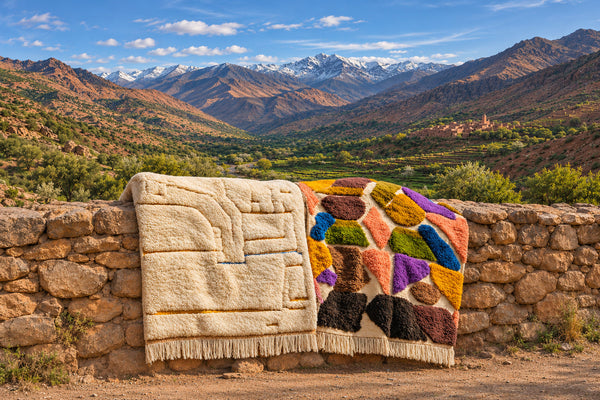
At Soul Rugs, we use natural wool from Morocco’s Atlas Mountains for our Mrirt collection. Amazigh women artisans weave our rugs to order, giving that wool its form, pattern and texture. The character of a Mrirt rug emerges through the choice of yarn, the weave and the finishing.
Understanding that relationship helps explain why two rugs made from the same material can offer different textures. A useful starting point is the wool itself, followed by the decisions that turn it into a particular design.
Atlas wool at the heart of Soul Rugs
The Atlas Mountains connect the material identity of our Mrirt rugs with Morocco’s Amazigh weaving traditions. Natural wool from this landscape is central to the collection. Its transformation into a rug depends on the knowledge and decisions of the women who work with it.
For the artisan, a design involves the thickness of the yarn, the arrangement of the weave, the placement of the pattern and the finishing of the pile. Those decisions become visible along the edge, where a line changes direction, or where a raised motif meets a lower area of pile.
Our Mrirt rugs are made to order. The design is therefore realised through the work of the weaver for a particular piece. The people behind that work are part of the story of the material itself. Meet the Amazigh women behind Soul Rugs
From wool fibre to the yarn you can see
Spinning brings wool fibres together into a continuous yarn. Its thickness and twist influence how the strands lie together in the rug. A close view can reveal their texture, the transitions between colours and the definition of a motif.
The fibre contributes its own qualities. Wool has natural elasticity and insulating properties, and fibre diameter influences how soft it feels. In a rug, these qualities combine with the weave and pile to create its texture. Woolmark’s explanation of wool fibre structure
To examine the wool in a photograph, look for a sharp close-up. A wider view helps you read the composition, while the detail shows how the strands and the lines of the pattern sit together.
How the artisan gives the pile its structure
The three Soul Rugs designs discussed below are described in our catalogue as hand-knotted. In this construction, the artisan works pile yarn into a woven foundation. The knots and supporting threads hold the rug together as it grows across the loom.
Maintaining tension, following the drawing and placing the yarn consistently all contribute to the clarity of the pattern. A curve has to remain legible through successive rows. A diamond line has to meet the next part of the pattern. Finishing brings those details into focus.
Several construction terms help explain what you are looking at.
| Feature | Meaning | Best way to assess it |
|---|---|---|
| Yarn | The spun wool strands used in the rug | A close-up of the field and pattern |
| Pile height | The height of the pile above its woven base | An edge or side view |
| Knot density | The number of knots within a measured area | A measured count or a scaled photograph of the reverse |
| Relief | Raised and lower areas within the design | An angled detail showing the differences in height |
Height and density describe separate features. A photograph can show a plush profile or a raised motif, while an exact knot count needs its own evidence. This distinction helps make the description of an individual Mrirt rug precise.
The wider sequence from preparing wool to weaving and finishing belongs to our article on the making process. How Moroccan rugs are made
Three textures from the Soul Rugs Mrirt collection
Ivory Wave and a sculpted surface
The Mrirt Ivory Wave Carved Plush Wool Rug combines an ivory field with sweeping organic waves. Its product description specifies a hand-knotted construction, a deep plush pile and hand-carved detailing.
Here, the pattern is carried by relief. Raised areas catch the light while the lower channels outline the movement of the waves. A close view of the pile and fringed edge shows how its depth contributes to the drawing. Carving gives the waves their definition.
Chocolate Brown Diamond and contrast within the pile
The Mrirt Chocolate Brown Diamond Wool Rug brings a deep chocolate-brown field together with an ivory diamond lattice. The catalogue describes it as hand-knotted with a plush high pile.
This design makes the relationship between colour and pattern easy to read. The lighter lines trace the geometry across the brown pile. Close views help show how the lattice meets and changes direction.
Golden Bordered and a medium profile
The Mrirt Golden Bordered Wool Rug is described as hand-knotted in natural wool, with a golden-camel field and a terracotta diamond border. Its specified profile is medium pile.
The border gives the composition a clear frame around the central field. Its medium-pile description also provides a useful comparison with the two high-pile examples above. Across these three designs, the same collection identity accommodates differences in colour, drawing, finishing and profile.
What colour and finishing tell you about the wool
An ivory field allows shadows and changes in pile height to become prominent. A contrasting lattice makes the drawing more immediately visible across the rug. Both approaches reflect choices in colour and the treatment of the pile.
Finishing gives those details their definition. Trimming can establish the profile of a pile, while carved detailing introduces changes in height within the design. The edge and fringe provide another place to examine how the main field ends and the rug is finished.
Does natural wool mean the yarn is undyed?
Natural wool describes the fibre used in the rug. The colour and its dyeing history are additional information. Soul Rugs’ Atlas wool identity includes both ivory and coloured designs. Statements about an undyed yarn, a particular dye source or a treatment belong to the details confirmed for the individual piece.
What does lanolin tell you about the finished rug?
Raw fleece contains wool grease. Washing, or scouring, removes grease and other impurities during preparation. The amount remaining after processing depends on how the wool was treated, so a claim about residual lanolin needs evidence for the material used in the particular rug. Woolmark’s explanation of wool scouring
Living with the wool and its texture
Think about the places where the rug will be touched and seen most often. Beside a bed, the feel of the pile against bare feet may be especially important. Around a seating area, the profile at the edges and the way the pattern reads across the floor may guide your choice.
Read the full view, the close-up and the edge profile together. The full view establishes the scale of the pattern. The close-up shows the finer details. The edge reveals the transition between the pile and the fringe, helping you picture the rug as an object with depth and defined edges.
Caring for the texture of a Moroccan wool rug
Follow the instructions for your particular rug and its colours. Regular gentle care helps manage loose dust and spills while respecting the pile and fringe.
- Vacuum on an appropriate low-suction setting, following the direction of the pile. Keep the vacuum head clear of the fringe.
- Blot fresh liquid spills promptly with a clean, absorbent cloth.
- Use a wool-compatible cleaning method and test a discreet area before treatment.
- For persistent stains or deeper cleaning, choose a professional familiar with wool rugs and their construction.
WoolSafe’s guidance explains how construction, soiling and the choice of cleaning method affect maintenance. WoolSafe guidance on wool carpet care
Explore the material through the designs
For the broader background to the style, its origins and its place among Moroccan rugs, our complete guide provides the next step. Read the complete guide to Mrirt rugs
To compare the designs, look at their full views alongside the surface and edge details. The collection brings together the Atlas wool, Amazigh craftsmanship and individual textures described here. Explore the Soul Rugs Mrirt collection