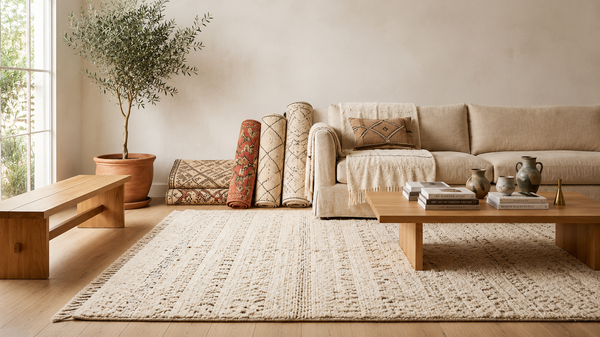
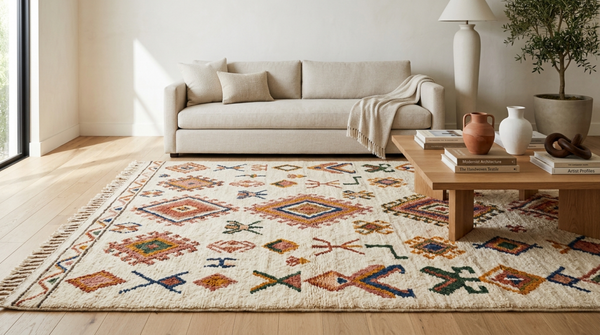
Among handwoven textiles, few have traveled as far as the Beni Ourain rug. From the high villages of Morocco’s Middle Atlas to the apartments of New York, the townhouses of London, and the studios of Paris, this rug — ivory, geometric, made entirely of natural wool — has become one of the defining objects of contemporary interior design.
But what makes a Beni Ourain rug what it is? The answer is not the pattern, nor the color palette, nor even the pile. It is the tradition that produced it: a practice of weaving transmitted, without interruption, from one generation of Amazigh women to the next, entirely by demonstration and memory. No written instructions. No industrial process. Just hands, wool, a vertical loom, and time.
This guide covers everything: the history and cultural context of Beni Ourain rugs, the techniques behind their making, the symbols woven into their surface, how to identify an authentic piece, and how to live with one in a modern home.
The Beni Ourain: Who Are They?
The name Beni Ourain refers not to a single community but to a confederation of seventeen Amazigh tribes indigenous to the Middle Atlas Mountains of Morocco. The Amazigh — the indigenous Berber people of North Africa — have long inhabited these mountains, and the women of the Beni Ourain confederation have been weaving rugs as part of their domestic and cultural life for many generations.
Their territory spans a high and demanding landscape: limestone plateaus, cedar forests, and mountain passes that remain snowbound through winter. The altitude shapes everything — the wool of the sheep that graze there, the pace of life, the textures of what the women make.
The tradition of weaving in this region is not a commercial practice that grew in response to external demand. It was, and in many communities remains, an integral part of how Amazigh women understand their role, their history, and their relationship to the domestic world. A young girl learns to weave from her mother or grandmother. She does not follow a written pattern. She learns by observation, by repetition, by doing — and over years, she develops her own visual language within a shared tradition.
The Visual Language: Symbols and Their Meaning
The geometric patterns that define Beni Ourain rugs are often interpreted through themes such as protection, fertility, and household life. These associations are part of a broader Amazigh visual culture, but they should not be read as a fixed universal code.
The Diamond
The diamond — or losange — is the most prevalent motif in Beni Ourain weaving. It appears in countless variations: single, doubled, nested, elongated, or fractured into smaller geometric units. In discussions of Amazigh visual culture, diamond forms are often associated with ideas of protection. Meanings can vary by community and weaver, so the motif is better understood as part of a living visual language than as a symbol with one fixed translation. Our ivory and black diamond lattice shows the nested form, repeated across the whole field.
The Broken Line
Broken, staggered, and zigzag lines are recurring features in Beni Ourain compositions. They are sometimes interpreted in relation to movement, continuity, or the course of life, but such readings vary. In practice, these lines also structure the composition and create visual rhythm. Our ivory and black broken stripe rug is built almost entirely on this device.
The Cross and the Lozenge Grid
Cross forms and repeating lozenge grids appear in more elaborate Beni Ourain compositions. Similar geometric forms recur across Amazigh textile traditions in North Africa. Their interpretation depends on context, region, and the individual weaver rather than on a single universal meaning.
It is worth noting that these meanings are not fixed and universal. Each weaver interprets the vocabulary in her own way. Some patterns are inherited almost verbatim from a grandmother; others are intuitive variations on a shared theme. What remains consistent is that the patterns carry intention.
How a Beni Ourain Rug Is Made
The Wool
The wool used for Beni Ourain rugs comes from sheep raised in Morocco’s Middle Atlas. Its natural texture, warmth, and resilience are central to the character of the finished rug.
Traditionally, the wool is left undyed. The ivory and cream tones of the ground come directly from the natural fleece. The dark motifs are worked in wool that is naturally dark, from sheep of a different coat. Contemporary interpretations may incorporate dyed wool and a broader range of colors while drawing on the same weaving heritage.
The Loom
At Soul Rugs, our Beni Ourain rugs are woven by hand on traditional looms. The artisan works row by row, building the rug gradually through the hand-knotting process.
The Knot
The pile is created through individual hand-tied knots — each one a length of wool looped around two warp threads and pulled tight. A single rug requires thousands of individual hand-tied knots, with the total depending on its dimensions and knot density. After each row of knots, the weaver passes a weft thread horizontally across the loom and beats it down to compress the pile. Then she moves on to the next row.
This process is slow by design. At Soul Rugs, a medium Beni Ourain rug around 5 by 8 feet typically takes three to five weeks of weaving. The exact time depends on the rug’s dimensions, knot density, and composition.
The Artisan’s Judgment
There is no drawing pinned to the loom, no pattern printed on graph paper. The weaver holds the composition in her mind, adjusting as she goes, reading the developing rug with a practiced eye. This is why no two Beni Ourain rugs are truly identical. The pattern on each piece is the product of one woman’s interpretation of a shared visual language — made in a particular place, in a particular season, at a particular point in her own life as a weaver.
The Beni Ourain Rug in International Design
The Beni Ourain rug’s presence in contemporary interior design is not new. European and American collectors began acquiring Moroccan Berber textiles in the early twentieth century — drawn by their graphic quality, their material honesty, and their formal affinity with the abstract art being made at the same moment in Europe.
In the postwar decades, architects and designers working in a modernist idiom — clean lines, neutral palettes, natural materials — found that Beni Ourain rugs worked naturally in the spaces they were creating. The rugs were brought into conversation with mid-century furniture, Scandinavian design, and minimalist architecture, and they held their own in every context.
Today, the Beni Ourain rug occupies an unusual cultural position: it is simultaneously a cultural object, a design icon, and a considered purchase for people who care deeply about what they bring into their homes. It appears in the houses of collectors and in the studios of architects. It has been specified by interior designers across Europe, North America, and Australia. And it remains, in all those contexts, entirely itself — resistant to trend, unchanged in its essential character.
How to Identify an Authentic Beni Ourain Rug
The market for Moroccan Berber rugs spans a wide range of quality and provenance, from genuine handwoven pieces made by individual artisans in the Atlas to machine-made reproductions produced at scale for export. Knowing the difference matters — both for the integrity of your purchase and for what you bring into your home.
Weight and Pile Density
Weight and pile density can offer useful clues when assessing a Beni Ourain rug, but they are not proof of authenticity on their own. A well-made hand-knotted piece should feel substantial and responsive for its construction, while pile height and density can vary according to the artisan, wool, dimensions, and intended character of the rug.
Natural Irregularity
Hand-knotting often produces subtle variations across the surface — small differences in pile height, minor shifts in geometry, or edges that are not perfectly uniform. These variations can reflect the hand of the artisan, but irregularity alone does not establish provenance. The most reliable assessment considers construction, materials, reverse structure, and documented origin together.
The Wool
Natural wool has a distinctive combination of softness, resilience, and subtle variation in texture and luster. These qualities can help distinguish it from many synthetic fibers, but touch and appearance alone are not definitive tests of authenticity. Fiber quality should be considered alongside the rug’s construction and provenance.
The Reverse
Turn an authentic hand-knotted Beni Ourain rug over and you will see the knots. Each one is individually tied and slightly irregular. A machine-made rug will show a uniform, looped or printed backing — and you will not be able to distinguish individual knots.
Provenance
The most reliable indicator is knowing where a rug comes from. Reputable sellers can tell you something about the artisan, the region, and the process. At Soul Rugs, every Beni Ourain rug is woven to order by an Amazigh artisan woman in the Middle Atlas — and we are happy to tell you more about the person who will make yours.
How to Style a Beni Ourain Rug in a Modern Home
The Beni Ourain rug’s most distinctive quality in an interior context is its neutrality. Its traditional palette — ivory, cream, and dark wool — is fundamentally versatile. It provides ground without competing for attention.
In a Minimalist or Scandinavian Space
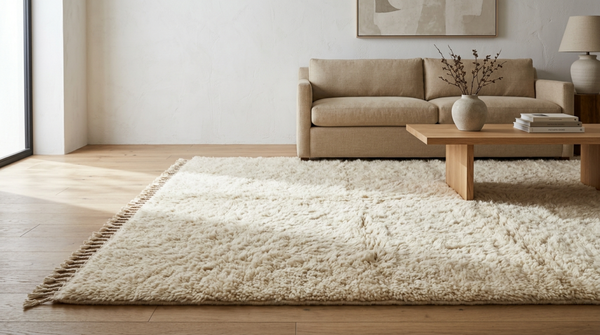
This is the context in which Beni Ourain rugs have been most widely used and photographed. A restrained room — pale walls, blonde wood, simple furniture — gains texture and warmth from a Beni Ourain without losing its sense of calm. The rug adds material richness while leaving the rest of the composition undisturbed. Our cream tonal lattice, with its fine brown honeycomb pattern on a cream ground, is one example of this quieter approach.
In a Warm, Mediterranean Interior
Beni Ourain rugs work equally well in warmer interiors: terracotta walls, linen upholstery, raw wood and natural stone. The ivory of the wool picks up the warmth of the room without overpowering it.
In a Bedroom
This is arguably the best use of a Beni Ourain rug — and the one most directly connected to its original function. Under a bed, extending two to three feet on either side and at the foot, the rug provides warmth underfoot and visual softness in a space that tends toward the spare. The natural lanolin in the wool makes it comfortable in close contact with bare feet.
Layering
Beni Ourain rugs layer well over sisal, jute, or flatweave kilims. The combination of texture and scale adds depth to a room without visual clutter. When layering, choose a ground rug in a neutral or natural tone, and ensure the Beni Ourain sits at least 8 inches within the border of the larger piece.
Beni Ourain Rug Size Guide
Selecting the right dimensions is as important as choosing the right rug. A piece that is too small reads as an afterthought; one that is too large can overwhelm a carefully considered room.
The guiding principle: a rug should anchor the furniture arrangement, not simply cover floor space. In a living room, the front legs of all major seating pieces should rest on the rug. In a bedroom, the rug should extend at least 24 inches on either side of the bed and at least 18 inches at the foot.
- 3 × 5 ft / 91 × 152 cm — Entryway, bedside, or small accent area
- 5 × 8 ft / 152 × 243 cm — Bedroom under a double or queen bed; small living room seating group
- 6 × 9 ft / 183 × 274 cm — Bedroom under a king bed; medium living room
- 8 × 10 ft / 243 × 304 cm — Standard living room; open-plan dining area
- 9 × 12 ft / 274 × 365 cm — Large living room; generous open-plan main space
If you are uncertain about which dimensions suit your space, our atelier is glad to advise. We can weave any Beni Ourain rug to a custom size — simply get in touch.
Frequently Asked Questions
What exactly is a Beni Ourain rug?
A Beni Ourain rug is an authentic handwoven wool rug made by Amazigh women artisans from the Beni Ourain tribal confederation in Morocco’s Middle Atlas Mountains. These rugs are traditionally defined by their natural ivory wool ground, geometric motifs in dark wool, and a medium-to-high hand-knotted pile.
Are all Beni Ourain rugs the same?
No. Every authentic Beni Ourain rug is unique. The pattern, proportions, pile density, and overall character of each piece reflect the individual artisan woman who made it. No two are identical.
How long does it take to make a Beni Ourain rug?
At Soul Rugs, a medium-sized Beni Ourain rug around 5 by 8 feet typically takes three to five weeks of weaving. The exact time depends on its dimensions, knot density, and composition.
How do I know if a Beni Ourain rug is authentic?
Key indicators include weight and pile density, natural wool texture, visible hand-tied knots on the reverse, slight geometric irregularities across the surface, and a verifiable provenance. At Soul Rugs, every piece is woven to order by an Amazigh artisan woman.
How should I care for a Beni Ourain rug?
Vacuum gently in the direction of the pile. Spot clean with cold water and a mild, pH-neutral detergent. Dry flat in shade — never in direct sunlight, which can gradually affect the natural ivory fibers. Professional cleaning every two to four years, depending on use, is recommended.
Why are Beni Ourain rugs expensive?
The price reflects the time, skill, and materials required to make a genuine piece. A single medium rug takes weeks of skilled labor, uses premium natural wool, and carries the accumulated expertise of a tradition transmitted through generations. Machine-made alternatives exist at lower price points — but they are not the same object.
Do you ship worldwide?
Yes. Every Soul Rugs piece ships free via DHL Express from our atelier in Marrakech. Once weaving is complete, delivery typically takes 5 to 7 business days via DHL Express.
Explore our Beni Ourain collection — each piece made to order by an Amazigh artisan woman in the Middle Atlas Mountains of Morocco. Read Our Story to learn about the people and the practice behind every rug.