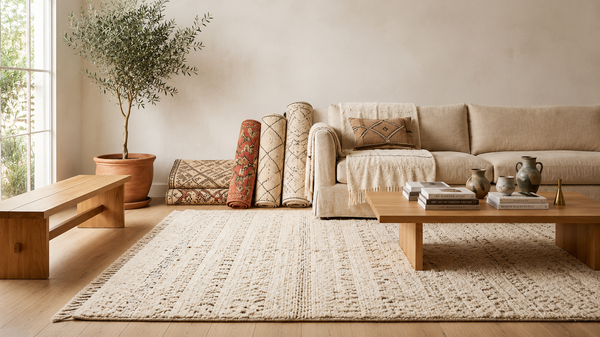
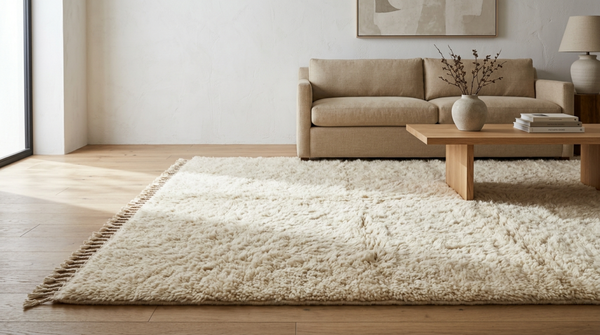
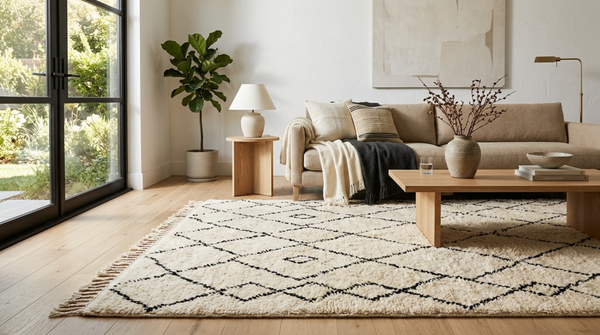
Among all the rugs that come from Morocco’s Atlas Mountains, the Azilal is the one most likely to stop you in your tracks. Not because of what it shares with the Beni Ourain — the natural wool, the Amazigh origins, the slow patient making — but because of what separates it entirely: color. Instinct. A visual freedom that belongs to the woman who made it and to no one else.
Where the Beni Ourain often feels more architectural and restrained, the Azilal tends toward a freer use of color and composition — abstract, personal, expressive.
This is a guide to that difference. It covers the geography and culture behind Azilal rugs, the way they are made, the colors that define them, how to read their compositions, and how to live with one in a modern home.
The Azilal Region: A Landscape That Shapes the Rug
High Atlas Geography and Isolation
The Azilal region lies in the central High Atlas, in the province that bears the same name, southeast of Beni Mellal. It is a landscape of dramatic vertical relief — deep gorges, high passes, remote valleys — that has historically made travel difficult and preserved both the communities that live there and the practices they have maintained.
The women who weave in the Azilal region work within a long-established High Atlas textile tradition. Geography, community knowledge, available materials, and individual practice all contribute to the character of Azilal weaving, without reducing that tradition to a single cause.
The High Atlas Landscape and the Language of Color
The High Atlas provides the physical and cultural setting in which Azilal weaving developed. Mountain light, vegetation, earth, architecture, clothing, and other textiles all form part of the visual environment surrounding the communities of the region.
It is tempting to draw a direct line between altitude and the colors used in an Azilal rug, but that relationship is difficult to establish as a factual rule. A safer way to understand the palette is as part of a broader visual culture shaped by place, available materials, inherited practices, and the individual choices of each weaver.
A Tradition of Personal Expression
Why Azilal Weavers Work Without a Fixed Pattern
Azilal rugs are often composed without a rigid pre-drawn pattern. Rather than following a template on paper or a diagram pinned to the loom, the weaver may draw on inherited motifs, familiar forms, and her own sense of palette and proportion as the composition develops row by row.
Beni Ourain rugs tend to use a more restrained geometric vocabulary, while Azilal rugs are often more expressive and varied in color and composition. An Azilal weaver may draw on symbolic forms she has encountered throughout her life — in other rugs, in the natural world, and in the visual language of her community — while making her own compositional choices as she works.
How Weaving Knowledge Is Passed On
Weaving knowledge in Azilal communities is passed through observation, practice, and guidance from experienced weavers. Technical skills — preparing wool, setting up the loom, knotting, and working with color — can be learned within families and communities, while the finished composition still leaves room for individual decisions.
This combination of shared technique and individual choice helps explain why handmade Azilal rugs can differ markedly even when they emerge from the same local tradition.
How Each Rug Carries the Weaver’s Own Visual Language
Handweaving and the artisan’s own compositional choices give each Azilal rug an individual character. Variations in color placement, proportion, rhythm, and detail reflect the decisions made during the weaving process and the hand of the person who made it.
Collectors and designers who understand this quality often speak of Azilal rugs the way they speak of paintings: as objects with an interior life, a point of view, a sensibility that belongs to the person who made them.
Color in Azilal Rugs: Natural Dyes and Living Hues
The Palette: Saffron, Indigo, Rose, Ochre, Forest Green
Color is central to the Azilal tradition, and historically Moroccan weavers have worked with a range of natural dye sources derived from plants, minerals, and other materials. Dye practices vary by period, community, and maker, however, and the use of natural dyes alone should not be treated as a universal test of authenticity. What remains distinctive is the way color is integrated into the handwoven composition, with subtle variations that reflect the materials and process.
The ground of most Azilal rugs is natural ivory — the undyed Atlas Mountain wool that also defines the traditional Beni Ourain. Against this ground, the colored elements stand with particular clarity. The ivory is not passive. It participates actively in the composition, serving as breathing space between areas of color, giving the eye somewhere to rest.
How Natural Dyes Age — and Why That Matters
Natural dyes can change over time as they are exposed to light, air, use, and cleaning. The way a color ages depends on the dye source, mordant, fiber, and conditions in which the rug is kept. Gradual shifts in tone are therefore a normal part of living with naturally dyed textiles, rather than a reliable distinction between natural and synthetic color.
This evolution is not a defect. It is part of the character of textiles made from natural materials and traditional processes. An Azilal rug can develop subtle changes in tone over years of use, giving the surface a patina shaped by its environment and care.
Ivory as the Foundation: What It Does for Color
The ivory ground in an Azilal rug does more than provide a neutral background. It connects the rug visually to the Beni Ourain tradition — grounding it in the material heritage of Amazigh weaving — while allowing the colored elements to read with maximum clarity. The warm ivory ground gives the composition breathing space and creates a soft visual contrast with the colored areas.
The relationship between the ivory ground and the colored elements is an important part of the Azilal aesthetic. In a handwoven piece, subtle variations in wool, color, and texture contribute to a surface that reflects the materials and the hand of the artisan.
Reading an Azilal Rug: Symbols, Forms and Meaning
Abstracted Figures: People, Animals, Landscapes
Azilal rugs often contain what appear to be figurative elements — simplified human forms, stylized animals, abstracted landscapes — though they are always rendered through the filter of the weaver’s own visual thinking, not as realistic representations. A form that suggests a person may have originated as a protective symbol, or as a response to something the weaver observed, or as a purely compositional decision whose meaning is entirely interior.
This openness is part of what makes Azilal rugs engaging to collectors. Unlike traditions where every motif has a fixed, documented meaning, the Azilal rug presents forms that invite interpretation without imposing it. You bring something to the reading; the weaver has already brought something to the making.
Geometric Instinct vs Beni Ourain Geometry
Both Beni Ourain and Azilal rugs contain geometric elements, but their visual character often differs. Beni Ourain rugs tend to use a more restrained geometric vocabulary, while Azilal rugs are often more varied in color, scale, and composition. In an Azilal rug, a diagonal line may shift direction partway through, or a color field may be interrupted by another form as the composition develops.
This contrast can give Beni Ourain rugs a more architectural presence, while Azilal rugs often feel closer to drawing or abstract composition.
Interpreting Motifs Without Overstating Meaning
Not every form in an Azilal rug can be assigned a single documented meaning. Some motifs may draw on familiar cultural references, while others function primarily as compositional choices. Without testimony from the individual weaver, it is better to avoid treating a specific form as a fixed statement of intention.
What can be observed with confidence is that the finished rug records a sequence of material and aesthetic decisions — choice of wool, color, spacing, rhythm, scale, and placement — made throughout the weaving process.
How an Azilal Rug Is Made
The High Atlas Loom: Same Structure, Different Intent
At Soul Rugs, our Azilal rugs are woven by hand on traditional looms, with the artisan building the rug gradually row by row.
At Soul Rugs, a medium Azilal rug around 5 by 8 feet typically takes three to five weeks of weaving. The exact time depends on its dimensions, construction, and complexity of the composition.
Wool Preparation and Natural Dyeing
When natural dyes are used, the wool is prepared and dyed before weaving begins. The dyeing process varies by weaver, dye source, and intended color. Some colorants require mordanting — a process of treating the fiber so that it accepts and holds the dye — before the dye bath. Natural dyeing can produce variation from one batch to another, and the weaver works with the resulting tones as part of the composition.
This variability can be one source of the visual richness found in naturally dyed textiles. Results can differ because of the wool, water, dye materials, duration and temperature of the dye bath, mordant, and the judgment of the person carrying out the process.
Building the Composition Row by Row
Once the yarn is ready, the artisan builds the rug row by row. Depending on the piece, she may work from a general idea of palette and proportion while adjusting details as the composition develops.
That ongoing decision-making is part of the handweaving process. It allows variations in color, spacing, scale, and rhythm to emerge within the broader visual language of Azilal weaving.
Azilal vs Beni Ourain: Which Rug is Right for You?
When to Choose an Azilal
An Azilal rug is the right choice when you want the rug to be a presence in the room — when you want it to carry visual energy and personality, to be the thing that makes the space feel inhabited rather than merely furnished. It works well in rooms that are otherwise spare, where its color and compositional vitality provide warmth without introducing clutter. It is also the natural choice for people who are drawn to art, craft, and objects with a discernible interior life.
When to Choose a Beni Ourain
A Beni Ourain is the right choice when the rug needs to support the room without leading it — when you want texture and warmth without strong color, when the architecture or the furniture already carries the visual weight and the rug’s role is to anchor the composition quietly. It is the rug of the designer who values restraint, and of the room where other objects carry the story.
For advice on the Beni Ourain tradition, our guide What is a Beni Ourain Rug? covers everything in detail, or you can browse our Beni Ourain collection.
Can You Have Both?
Yes. Azilal and Beni Ourain rugs can coexist in the same home — and often do. The key is to use them in different spaces and allow each to operate on its own terms. A Beni Ourain in the living room, an Azilal in a bedroom or studio. Or a large Azilal as the anchor of an open-plan space, with a smaller Beni Ourain as a secondary element in an adjacent area. The contrast between the two traditions, when handled thoughtfully, can be genuinely compelling.
Why Interior Designers Love Azilal Rugs
Color Without Visual Chaos
The most common question about Azilal rugs from people encountering them for the first time is: how does something so colorful not overwhelm a room? Much of the answer lies in the composition itself. The ivory ground that runs through many Azilal rugs creates visual breathing room between areas of color, while the handwoven surface introduces subtle variation in tone and texture. Together, these qualities can make even a richly colored piece feel balanced within a room.
Interior designers who specify Azilal rugs regularly — and there are many, particularly in Europe and North America — understand this well. A well-chosen Azilal brings color into a room without introducing the tension that color can carry when it is handled clumsily. It reads as warmth, not noise.
The Rise of Collectible Textile Art
Over the past decade, a meaningful shift has taken place in how collectors and designers understand handwoven textiles. The category of “collectible design” — which once applied almost exclusively to furniture and ceramics — has expanded to include textiles made by hand, with a distinct point of view, by a traceable maker. Azilal rugs fit naturally into this expanded category.
Their qualities — individual character, material honesty, traceable origin, the presence of a genuine creative sensibility — are exactly the qualities that discerning collectors value. A well-made Azilal rug is not simply a floor covering. It is an object with provenance, character, and a story that belongs to a specific person and a specific place.
Why No Two Pieces Are Ever Alike
Azilal rugs can vary significantly from one piece to another because the composition develops through the weaving process and reflects the choices of the individual artisan. Even when similar motifs, palettes, or proportions recur, the placement, scale, and details can differ substantially.
For collectors and designers, this individual character is part of the appeal. Handmade variation gives each piece a distinct presence without requiring the claim that a composition could never be repeated.
How to Style an Azilal Rug in a Modern Interior
In a Restrained, Minimal Space — The Unexpected Move
The counterintuitive placement for an Azilal rug is a minimal room — white walls, simple architecture, pale wood and linen. Precisely because the room offers no competition, the rug operates freely. Its color is given maximum space to register. The effect is not busy or overwhelming; it is focal. The room is organized around the rug rather than in spite of it.
This is the approach many designers now prefer: use an Azilal not as an accent but as the central object from which everything else in the room is derived. Start with the rug, and let it guide the decisions about what sits beside it.
In a Layered, Eclectic Interior
Azilal rugs also work well in more layered environments — rooms with varied textures, collected objects, a mixture of periods and materials. In this context, they contribute to the overall richness of the space without becoming the sole focus. The key is to ensure that the tones in the rug connect to at least some of the other elements in the room: a throw, a painting, a ceramic piece. These connections do not need to be exact; they need only to be felt.
As the Focal Point of a Room
In some rooms, the Azilal simply needs to be the thing people notice when they enter. Given space — a generous living room, an open-plan area with a high ceiling — an Azilal rug of substantial size can define the room’s character entirely. In this application, the furniture is chosen to complement the rug, not the other way around.
What to Pair With — and What to Avoid
Natural materials work with Azilal rugs in every context: raw oak, linen, unglazed ceramic, aged leather. They share the same material honesty and respond to light in similar ways. Highly polished surfaces — lacquered furniture, reflective flooring, high-gloss paint — tend to create a tonal disconnect with the warm, matte character of natural wool.
When it comes to other textiles in the room, restraint helps. Let the Azilal carry the pattern and the color; keep everything else quiet.
Frequently Asked Questions
What is an Azilal rug?
An Azilal rug is a handwoven Moroccan Berber wool rug made by Amazigh women artisans in the Azilal region of Morocco’s High Atlas Mountains. These rugs are known for their expressive use of color, abstract compositions, and the individual character that comes from handweaving.
Where do Azilal rugs come from?
Azilal rugs come from the Azilal province of Morocco, in the central High Atlas — a region of dramatic mountain landscape and long-established Amazigh weaving traditions. Geography and community traditions form part of the cultural context in which Azilal weaving developed.
How are the colors made — are they natural?
Natural dyeing is part of Morocco’s textile heritage and can be used in Azilal weaving, with colors derived from plant, mineral, and other traditional sources. Dye practices vary by period, community, and maker, however, so natural dyes should not be treated as a universal test of authenticity. When evaluating a rug, construction, materials, workmanship, and provenance are more useful indicators than dye type alone.
Are all Azilal rugs different?
Handmade Azilal rugs can vary significantly in composition, color placement, and detail from one piece to another. Individual choices made during the weaving process give each rug its own character, even when familiar motifs or palettes recur.
How does an Azilal rug compare to a Beni Ourain?
The two rugs share Amazigh weaving roots and a strong relationship to wool and handcraft. Beni Ourain rugs tend to use a more restrained geometric vocabulary and an ivory-and-dark palette, while Azilal rugs are often more expressive and varied in color and composition. For a full comparison, see our guide What is a Beni Ourain Rug?
How do I care for an Azilal rug?
Vacuum regularly with a low-suction setting, in the direction of the pile. Spot clean with cold water and a pH-neutral detergent. Dry flat in shade, as extended direct sunlight can gradually affect textile colors. Professional cleaning every two to four years, depending on use, is recommended. Naturally dyed fibers can shift in tone over time depending on light exposure, use, and care.
Do you ship worldwide?
Yes. Every Soul Rugs piece ships free via DHL Express from our atelier in Marrakech. Once weaving is complete, delivery typically takes 5 to 7 business days via DHL Express.
Explore our Azilal collection — each piece made to order by an Amazigh artisan woman in the High Atlas Mountains of Morocco. For a broader introduction to Moroccan rug traditions, see The Complete Guide to Moroccan Rugs. Or read Our Story to meet the people behind every rug.