Moroccan rugs occupy an unusual place in the world of handwoven textiles. They are, at the same time, among the oldest surviving craft traditions in North Africa and among the most sought-after objects in contemporary interior design. They are made by women in mountain villages using techniques that have not fundamentally changed in generations — and they end up in apartments in New York, houses in London, and studios in Copenhagen, where they anchor rooms and outlast every trend that surrounds them.
This guide is a starting point. It covers the main types of Moroccan rugs, how they are made, how to choose the right one for your home, and what to look for when buying. For deeper reading on each tradition, we have written complete guides to the Beni Ourain, the Azilal, and the Mrirt — the three traditions that form the core of the Soul Rugs collection.
What Makes Moroccan Rugs Unique?
Four qualities distinguish authentic Moroccan rugs from most other handwoven textiles available today, and from the many imitations that share their aesthetic.
They are made by women. In every Amazigh rug-weaving tradition in Morocco, the weavers are women. The knowledge is theirs — transmitted from mother to daughter, from grandmother to granddaughter, through observation and practice rather than written instruction. The rug you receive carries the work of a specific person.
They use natural wool. Authentic Moroccan rugs are made from wool sheared from sheep that graze in the Atlas Mountains at altitude. This wool is lanolin-rich, naturally resilient, and materially different from lowland fiber or synthetic alternatives. It is the foundation of everything that makes these rugs worth having.
At Soul Rugs, every rug is made to order. We do not hold stock. When you place an order, your rug is woven specifically for you — your dimensions, your chosen tradition, your piece. This is how we work, and it is how we ensure that every rug that leaves our atelier has been made with care for a specific person and a specific space.
Each piece is singular. Because every rug is woven by hand, without industrial standardization, no two pieces are identical. The variations — in proportion, in the character of the pattern, in the subtle differences of pile — are the marks of the making, not defects to be corrected.
The Amazigh Tradition: The People Behind Every Rug
Who the Amazigh Are
The Amazigh — the indigenous Berber people of North Africa — are the weavers behind every rug in the Soul Rugs collection. They are not a single community but a broad group of peoples who have inhabited the Atlas Mountains and the surrounding regions of Morocco, Algeria, Tunisia, and beyond for many generations. Their languages, customs, and visual cultures vary by region, but they share a common identity and a common relationship to the land.
In Morocco, the Amazigh communities of the Middle and High Atlas are where the major handwoven rug traditions developed. The Beni Ourain, the people of the Mrirt plateau, and the weavers of the Azilal valleys each developed their own distinct aesthetic — shaped by their geography, their climate, and the specific visual inheritance of their community.
Why Weaving Is Women's Knowledge
In Amazigh culture, weaving is entirely a women’s practice. It is not a professional designation or a commercial specialization — it is a fundamental part of how Amazigh women have understood their role in the household and their relationship to cultural continuity. A woman who weaves well is a woman who carries and transmits something of value.
The knowledge transfers without writing. A grandmother sits at the loom; her granddaughter watches. Over years, the granddaughter learns through proximity and repetition — not by reading a manual, but by doing what she has seen done. This mode of transmission is why the traditions have remained coherent across generations, and why they are genuinely difficult to replicate outside the communities that hold them.
The Atlas Mountains as a Source
The Atlas Mountains are not simply the geographic origin of Moroccan rugs. They are an active presence in what those rugs are made of. The sheep that graze on the Middle and High Atlas plateaus produce a wool that is shaped by altitude, cold, and highland vegetation — denser, more lanolin-rich, and more resilient than lowland fiber. The water used in wool preparation comes from mountain sources. The dyes, in the Azilal tradition, derive from plants that grow in specific valleys at specific elevations.
The rug you bring into your home carries, in a literal material sense, something of that landscape.
The Main Types of Moroccan Rugs
Beni Ourain Rugs
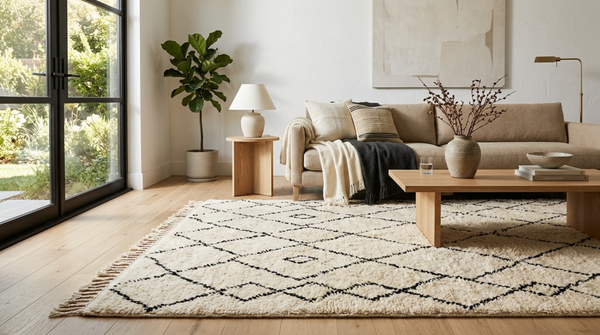
The Beni Ourain is the most internationally recognized of all Moroccan rug traditions — the one that appears most frequently in interior design publications, that has been most widely collected, and that has most influenced the vocabulary of contemporary design. Its visual signature is unmistakable: natural ivory or cream wool ground, bold geometric motifs in dark wool, medium-to-high hand-knotted pile.
The Beni Ourain rug comes from the Middle Atlas, where the women of the Beni Ourain tribal confederation have woven within a codified geometric vocabulary for many generations. The symbols — diamonds, broken lines, lozenge grids — are not merely decorative. They belong to a visual language whose meanings are carried within the tradition itself.
For a complete account of the Beni Ourain tradition, its making, its symbolism, and how to identify an authentic piece, see What is a Beni Ourain Rug? The Complete Guide. To explore the collection, visit our Beni Ourain rugs.
Azilal Rugs
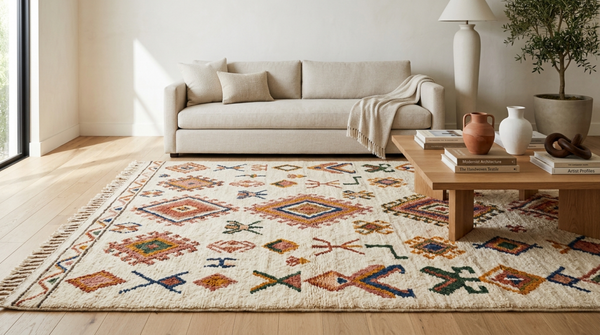
The Azilal rug is the most expressive and visually individual of the three traditions. Where the Beni Ourain works within a codified geometric vocabulary, the Azilal weaver composes without a pattern — following her own visual instinct, row by row, producing a piece that reflects her personal sensibility rather than an inherited template.
Azilal rugs are known for their expressive use of color, with palettes that can range from vivid reds and blues to softer ochre, green, and rose tones. No two Azilal rugs share the same composition. The tradition comes from the Azilal province of Morocco’s High Atlas, where the isolation of mountain communities preserved a weaving practice of unusual creative freedom.
For the full guide to Azilal rugs, see What is an Azilal Rug? The Complete Guide. To explore the collection, visit our Azilal rugs.
Mrirt Rugs
The Mrirt is the least known internationally and, for those who have encountered it in person, often the most immediately impressive. Its distinction is material rather than visual: an exceptionally dense pile, woven to a height and knot density that exceeds most other Moroccan rug traditions, from lanolin-rich wool produced on the Middle Atlas plateau around the town of Mrirt.
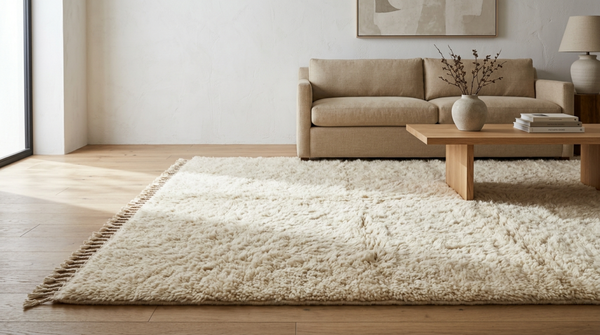
A Mrirt rug does not announce itself the way an Azilal does. Its compositions tend toward restraint — tonal, quietly geometric, visually unhurried. What it offers instead is a surface quality that is experienced underfoot rather than appreciated from across a room: dense, yielding, warm in the specific way of high-quality natural wool at significant pile depth.
For the complete guide to Mrirt rugs, see What is a Mrirt Rug? The Complete Guide. To explore the collection, visit our Mrirt rugs.
Other Moroccan Rug Traditions
Beyond the three traditions in the Soul Rugs collection, Morocco has a rich textile heritage that includes the kilim — a flat-woven rug without pile, often in bold geometric patterns — the boucherouite, made from recycled fabric strips and known for its vivid, improvisational compositions, and the zanafi, a mixed flat-and-pile weave from the southern regions. Each has its own visual character and cultural context. At Soul Rugs, we focus on the Beni Ourain, Azilal, and Mrirt traditions because they represent, in our view, the deepest and most materially refined expressions of Amazigh weaving in the Atlas Mountains.
Not sure which tradition is right for your space? Explore our three collections: Beni Ourain · Azilal · Mrirt
How Moroccan Rugs Are Made
The Vertical Loom: Unchanged in Intent
The hand-knotted rugs in the Soul Rugs collection are woven on vertical looms, where the warp threads run from top to bottom and the weaver builds the rug row by row.
Hand-Knotting: What It Means in Practice
The pile of a Moroccan rug is created through individual hand-tied knots — each one a length of wool looped around two warp threads and secured. After each row of knots, the weaver passes a weft thread horizontally and beats the row downward to compress the pile. This process, repeated thousands of times, builds the surface of the rug from the bottom up.
The quality of the finished pile — its evenness, its density, its resilience — depends entirely on the consistency of the weaver’s tension and the care with which she compresses each row. These are skills that develop over years and that cannot be replicated by a machine in the same way.
Natural Wool: From Sheep to Finished Pile
The wool used in authentic Moroccan rugs begins with sheep raised on the Atlas plateaus. It is sheared, washed, carded, and spun — often by the weaver or by women in her community — before being brought to the loom. In traditions like the Beni Ourain and Mrirt, the wool is used undyed; in the Azilal tradition, it is dyed with natural pigments before weaving begins.
At every stage, the material is handled with close attention to the character of the wool and the requirements of the weaving process. The result is a wool that ages well, maintains its natural properties over time, and produces a rug that improves with careful use rather than deteriorating under it.
From Order to Your Door: 5–6 Weeks
At Soul Rugs, every rug is made to order. When you place your order, we work with our atelier to match your piece to an Amazigh artisan woman who specialises in the tradition you have chosen. She begins weaving your rug — your dimensions, your specific piece — and works on it through to completion. Total lead time from order to delivery is 5 to 6 weeks. Once complete, your rug ships free via DHL Express from our atelier in Marrakech.
How to Choose the Right Moroccan Rug
By Room
The room where a rug will live should be the first consideration, because different rooms reward different qualities.
Living room: The rug needs to anchor a seating group and be appreciated from a standing distance. The Beni Ourain works well here — its graphic clarity reads across a room. An Azilal, in a restrained living room, can serve as the central visual element from which the rest of the space is organized.
Bedroom: The priority shifts from visual impact to tactile quality. The Mrirt is the natural choice — its exceptional pile depth is most fully appreciated underfoot in the morning, against bare skin. A Beni Ourain also works well under a bed, where its neutral palette complements most bedroom schemes.
Study or library: A space where the rug is in continuous close contact with someone seated or standing deserves material quality above all. The Mrirt again; or a Beni Ourain in a more graphic space.
Entryway: An Azilal introduces color and personality at the threshold without requiring the decorative discipline of a larger room. A smaller Beni Ourain works equally well in a more neutral entry.
By Interior Style
Minimalist or Scandinavian: The Beni Ourain is the natural choice here — its neutral palette and geometric precision complement the restraint of these aesthetics without competing with it.
Eclectic or collected: An Azilal thrives in a room with varied textures, periods, and materials. Its color and compositional individuality read as belonging rather than clashing.
Luxury with natural materials: The Mrirt is the rug for rooms where stone, oak, and linen are the design language. Its material quality matches and complements.
Warm Mediterranean or earthy: Both the Azilal and the Beni Ourain work well. The Azilal brings color that complements warm terracotta and ochre tones; the Beni Ourain brings the ivory warmth of natural wool.
By Color Palette
If your room is neutral: Both the Beni Ourain and the Mrirt are natural partners — their tonal character reinforces rather than interrupts a considered neutral scheme.
If you want to introduce color: The Azilal is the obvious choice. Its natural dye palette — saffron, indigo, rose, ochre — introduces warmth without the harshness of synthetic color.
If you want texture to do the work: The Mrirt prioritizes surface over pattern. It adds depth and material richness to a room without introducing a visual element that needs to be managed.
By What Matters Most to You
Some buyers choose a rug for how it looks. Others choose it for what it is — the tradition behind it, the material quality, the story it carries. The Soul Rugs collection is built around the second kind of choice. But within that, the three traditions offer meaningfully different experiences.
If visual impact and creative individuality matter most, the Azilal. If heritage, geometry, and versatility, the Beni Ourain. If material quality, structural longevity, and tactile refinement, the Mrirt. If you would like guidance, our atelier is glad to help.
Moroccan Rug Size Guide

Size is, consistently, the decision that buyers most often get wrong — and almost always in the same direction. The rug is too small. A rug that floats in the center of a room without connecting to the furniture around it looks provisional, like a placeholder for the real rug that will eventually arrive. The correct size makes the room feel resolved. Here is how to think through each space.
Living room. For a standard seating arrangement — sofa, two chairs, coffee table — an 8 × 10 foot rug is usually the minimum that reads as intentional. If the room is generous in proportion, a 9 × 12 serves better. The goal is to have all front legs of the seating on the rug, or ideally all four legs. When in doubt, measure from the outer edge of the sofa to the outer edge of the facing chairs; the rug should extend at least 12 inches beyond both.
Bedroom. Two approaches work well. A large rug — 8 × 10 or 9 × 12 — positioned under the lower two-thirds of the bed with 24 to 36 inches extending on each side and at the foot creates a unified frame for the room. Two runners placed on either side of the bed work in smaller rooms where a large rug isn't practical. What doesn't work is a small rug placed only at the foot of the bed with nothing at the sides — it looks unresolved regardless of the rug's quality.
Dining room. The rug must extend far enough beyond the table that chairs remain on the rug even when pulled out for seating. Twenty-four inches beyond the table edge is the workable minimum; thirty inches is more comfortable. For a table seating six — approximately 36 × 72 inches — a 9 × 12 rug is generally the appropriate minimum. Getting this wrong is immediately obvious every time someone sits down to eat.
Hallway. A runner that extends close to the walls reads as intentional; one that floats in the center of a wide corridor looks uncertain. Runners in hallways are as much architectural as decorative — they define the path and give movement through the space a quality it wouldn't otherwise have. Measure the hall carefully and err toward filling it.
Entryway. The entry takes concentrated impact — grit, moisture, direct foot traffic. Lower pile or flat-woven pieces are more practical here than luxury high-pile rugs. Choose something you can clean easily and, eventually, replace without regret; the entry is a functional zone before it is a decorative one.
Home office. A rug extending under the full desk and chair area defines the workspace and noticeably reduces sound in hard-floored rooms. A 5 × 8 typically covers a single-desk setup. One essential point: high-pile rugs and rolling desk chairs are genuinely incompatible. The resistance is real and persistent. Choose a low-pile or flat-woven piece for any space where a desk chair rolls.
Buying advice. Before ordering, tape out the proposed rug dimensions on your floor using painter's tape, with the furniture arranged as it normally would be. Leave the tape down for a full day and live with the outline. What seems too large in the abstract frequently resolves correctly when seen in the actual room — and what felt right often reveals itself as too small once the furniture context is in place.
Moroccan Rugs in Modern Interior Design
Why They Work in Contemporary Homes
Moroccan rugs have sustained their presence in contemporary interiors for decades because they possess qualities that designed objects often lack: material honesty, individuality, and the kind of presence that comes from something made slowly and well by a person rather than a process. In rooms where everything else is designed — considered, specified, produced — a handwoven rug introduces a different register entirely.
The best Moroccan rugs do not look designed. They look found. And in a context where considered interiors are increasingly composed of objects chosen for their authenticity rather than their novelty, this quality is valuable.
How Designers Use Moroccan Rugs as Anchors
In practice, the most common way that interior designers use Moroccan rugs is as the foundational object from which a room is organized. The rug is specified first — before the furniture, before the wall color, before the secondary objects. Everything else is chosen in relation to it.
This approach works because Moroccan rugs are strong enough to anchor a composition without demanding that everything else submit to them. A Beni Ourain creates a quiet foundation. An Azilal creates a focal point. A Mrirt creates a field of material quality that elevates every object placed near it.
The Question of Layering
Layering rugs — placing a smaller rug on top of a larger, flatter one — is a technique that works particularly well with Moroccan textiles. A Beni Ourain or Azilal layered over a flat-woven sisal or jute base gains additional visual weight and a sense of considered placement. The key is proportion: the upper rug should sit well within the borders of the lower one, with enough of the ground rug visible to establish the layering rather than obscure it.
Why Moroccan Rugs Remain Relevant Today
Handmade in an Age of Mass Production
At a moment when most objects in the home are produced at scale, by machines, in quantities that make individual character impossible, a handwoven Moroccan rug represents something genuinely different. It was made by one person, on one loom, over several weeks of sustained work. No two pieces from the same tradition are identical. The variations are not errors — they are evidence.
For buyers who are thinking carefully about what they bring into their homes — about where things come from, how they are made, and what they mean — this distinction matters. A Moroccan rug is not a product. It is the record of a practice.
Natural Materials in Contemporary Interiors
The shift toward natural materials in residential design — wool, linen, stone, oak, raw plaster — reflects a broader movement toward objects that are honest about what they are made of, that age gracefully, and that improve rather than deteriorate with careful use. Moroccan rugs have always belonged to this material family. Their relevance today is partly the relevance of natural wool itself: warm, resilient, lanolin-rich, and difficult to fully replicate in synthetic form.
In this context, a genuine Moroccan rug is not a trend object. It is the kind of thing that makes trend objects look temporary.
Why Authenticity Matters More Than Trends
The market for Moroccan-style rugs has expanded significantly as interest in the aesthetic has grown. Not everything sold as a Moroccan rug is made in Morocco, by hand, from natural wool, by a woman in the Atlas Mountains. Understanding the difference — and choosing accordingly — matters both for the quality of what you own and for the people whose work you are supporting.
An authentic Moroccan rug, made by an Amazigh artisan woman in the conditions and with the materials that define the tradition, is an object of genuine value. It was worth making. It is worth having. And it will be worth keeping for a long time.
Authentic vs Imitation: What to Look For When Buying
Provenance and Transparency
The most reliable starting point when buying a Moroccan rug is a seller who can tell you something meaningful about its origin: the region it comes from, the tradition it belongs to, and ideally something about the person who made it. Transparency about provenance is a basic condition of an honest transaction, and it is the first thing worth asking about.
At Soul Rugs, every rug is made to order and woven by an Amazigh artisan woman in the Atlas Mountains of Morocco. We are happy to share what we know about the person who will make your rug and the tradition it comes from.
Wool Quality
Authentic Moroccan rugs are made from natural wool — specifically, wool from sheep raised in the Atlas region. This wool has a particular character: warm rather than cool to the touch, slightly elastic under the hand, and carrying the faint, clean quality of natural lanolin. It absorbs light rather than reflecting it, and it behaves differently from lowland wool or synthetic fiber in ways that become apparent with handling.
Wool quality is something that develops with experience, but a few indicators are useful. Natural wool feels responsive and slightly variable in texture. It does not have the uniform slickness of synthetic fiber, nor the dullness of heavily processed wool. When in doubt, ask the seller what the wool is and where it comes from.
Construction
A hand-knotted pile rug, when turned over, reveals its construction directly: individual knots, slightly irregular, tied around pairs of warp threads. The reverse of the rug should show this structure clearly. A flat, uniform backing without visible knotwork typically indicates a different construction method.
Pile evenness is also worth considering. A well-made rug has a pile that is consistent in height and density across the full surface. Significant variation in pile depth, or areas where the pile lies flat rather than standing upright, may indicate uneven construction or lower-quality fiber.
Questions Worth Asking
Before purchasing, a few questions are worth putting to any seller: Where was this rug made? Who made it? What is the wool? Is it hand-knotted? These are not difficult questions for a seller with genuine knowledge of their product to answer. The quality of the response — and the ease with which it is given — tells you a great deal about what you are buying.
How to Care for a Handmade Moroccan Rug

Handmade wool rugs are more resilient than people tend to assume, and less fragile than their price might suggest. With attentive but not complicated care, they improve over time — the pile softening gradually, the colors settling, the piece developing the particular quality that is only available to things that have genuinely been lived with. A rug that has served a household for twenty years carries something that a new one cannot.
Vacuuming. Vacuum regularly — once a week in trafficked areas, less frequently in bedrooms and lower-use spaces. Use suction only, without the beater bar, and move in the direction of the pile rather than against it. The beater bar that works well on machine-made wall-to-wall carpet is unnecessarily aggressive on hand-knotted pile; over time, it accelerates wear at the fiber base. For high-pile pieces like Mrirt rugs, taking the rug outdoors for a gentle shake every few months is more effective than vacuuming alone at removing deeply settled fine dust.
Rotation. Rotate the rug 180 degrees every six to twelve months. Uneven wear and uneven fading are both consequences of leaving a rug in the same orientation indefinitely. Rotation distributes both across the surface evenly, extending the rug's working life and visual freshness considerably.
Spills. Speed matters more than method. Blot — never rub — immediately with a clean, dry cloth to absorb as much liquid as possible. Rubbing moves the spill laterally and embeds it more deeply into the pile; blotting lifts it out. For most water-based spills, prompt blotting is sufficient. For anything more persistent, a small amount of cold water and mild soap applied carefully with a cloth, then blotted dry, handles the majority of situations. Avoid saturating the rug.
Common mistake. Using warm or hot water on a wool spill. Hot water can felt wool fibers — causing them to mat and tighten irreversibly — and can set certain stains rather than lifting them. Cold water only, always.
Professional washing. Every two to four years, depending on how heavily the rug is used, a professional wash is worthwhile. This is not the same as a standard carpet cleaning service. Handmade wool rugs should be washed by a specialist who understands the difference between hand-knotted pile and machine-made carpet. Ask specifically whether the service washes handmade Oriental or Moroccan rugs; a competent specialist will know immediately what you mean.
Sun and humidity. Direct, prolonged sun exposure fades wool over time — natural dyes are generally more susceptible than high-quality synthetic ones, though both are affected. Window treatments that reduce peak-hour exposure help in rooms with strong south- or west-facing windows. In humid climates, a breathable rug pad that allows air circulation between the rug and the floor helps prevent moisture accumulation.
Storage. If a rug needs to be stored, roll it along the pile direction rather than folding it — folding creates creases that can become permanent. Wrap in breathable cotton fabric or acid-free paper rather than plastic, which traps moisture. Store in a cool, dry, dark location. Wool is a protein fiber and attractive to moths; cedar or lavender sachets placed near stored textiles are sensible precautions.
Choosing Between Beni Ourain, Azilal and Mrirt
The three traditions share their Amazigh origins, their Atlas Mountain wool, and their hand-knotting technique. What distinguishes them is their sensibility — and choosing between them is ultimately a question of what you want a rug to do in a room.
Beni Ourain — for spaces that value visual clarity, geometric heritage, and a neutral palette that works with almost everything. The rug of restraint and precision. Read the complete guide or explore the collection.
Azilal — for spaces that welcome color, creative individuality, and a piece that functions as much as an artwork as a floor covering. The rug of expression and vitality. Read the complete guide or explore the collection.
Mrirt — for spaces where material quality is the design language: natural stone, pale oak, linen. The rug of density, softness, and tactile refinement. Read the complete guide or explore the collection.
Frequently Asked Questions
What are the main types of Moroccan rugs?
The three traditions at the core of the Soul Rugs collection are the Beni Ourain, the Azilal, and the Mrirt. Each has a distinct visual character and material quality. Morocco also has a broader textile heritage that includes kilims, boucherouites, and zanafi weaves.
Are authentic Moroccan rugs handmade?
Yes. Every authentic Moroccan rug in the Amazigh tradition is handwoven on a vertical loom by a woman artisan, using hand-tied knots built row by row over several weeks. There is no mechanical stage in the production of a genuine handwoven piece.
How long does it take to make a Moroccan rug?
At Soul Rugs, total lead time from order to delivery is 5 to 6 weeks. The weaving alone takes several weeks of full-day work; the remainder covers finishing, quality review, and shipping via DHL Express from Marrakech.
What is the difference between Beni Ourain, Azilal and Mrirt rugs?
Beni Ourain rugs are defined by their ivory ground and geometric dark-wool motifs — precise, codified, visually neutral. Azilal rugs are composed intuitively in natural color, without a fixed pattern, by each individual weaver. Mrirt rugs are distinguished by their exceptional pile depth and knot density — materially refined, visually restrained. For full detail on each, see the Beni Ourain guide, the Azilal guide, and the Mrirt guide.
How do I choose the right size for a Moroccan rug?
In a living room, the rug should be large enough for the front legs of all major seating pieces to rest on it. In a bedroom, it should extend at least 24 inches beyond each side of the bed and 18 inches at the foot. Common sizes: 5×8 ft for bedrooms and small living rooms; 8×10 ft for standard living rooms; 9×12 ft for larger open-plan spaces.
Are Moroccan rugs good quality?
Authentic handwoven Moroccan rugs — made from natural Atlas Mountain wool, hand-knotted by experienced Amazigh artisan women — are among the most durable and materially honest floor coverings available. They are designed to be used, and to improve with careful use over time.
How do I care for a Moroccan wool rug?
Vacuum regularly with a low-suction setting, in the direction of the pile. Spot clean promptly with cold water and a mild, pH-neutral detergent. Dry flat in shade. Rotate every few months for even wear. A professional wash every two to four years, depending on use, is worthwhile for pieces in regular use.
Do you ship Moroccan rugs worldwide?
Yes. Every Soul Rugs piece ships free via DHL Express from our atelier in Marrakech. Once weaving is complete, delivery typically takes 5 to 7 business days. We ship to the USA, Canada, Europe, Australia, and over 100 countries worldwide.
Are handmade Moroccan rugs as durable as machine-made alternatives?
In many respects, more so. A well-made hand-knotted rug constructed from quality natural wool has structural integrity that most machine-produced alternatives don't approach. The knots are tied around warp threads individually; the pile does not separate from a backing under wear. Many authentically handmade Moroccan rugs remain structurally sound and visually compelling after decades of regular use. Machine-made rugs of comparable visible quality typically show more rapid deterioration at the pile base.
How can I tell if a Moroccan rug is genuinely handmade?
Turn it over and look at the back. In a hand-knotted rug, the pattern is visible on the reverse and the individual knots are tactile and visible — no two rows mechanically identical. Machine-made rugs have a latex or fabric backing that conceals the construction entirely. The pile of handmade rugs also carries a slight variation in cut height and density that machine processes eliminate; it is most apparent when the rug is seen in raking natural light.
Why does my new Moroccan rug have a noticeable wool smell?
Natural wool retains lanolin — the waxy protective coating found in sheep's fleece — through processing. This produces an earthy scent that is normal, harmless, and temporary. Air the rug in a well-ventilated space for a day or two and the scent dissipates considerably. In a normally ventilated room, it resolves entirely within a few weeks of regular use.
Can Moroccan rugs be used over underfloor heating?
Generally yes. Wool conducts radiant heat reasonably well, and most underfloor heating systems function normally beneath a Moroccan rug. Dense pile reduces heat transfer efficiency slightly. A breathable rug pad is recommended for both stability and air movement. Monitor the underside periodically to confirm it remains dry, particularly with higher-output systems.
What is the difference between a Moroccan rug and a Berber rug?
The terms are often used interchangeably. Many Moroccan rugs are accurately described as Berber rugs, as they are woven by Amazigh (Berber) artisans within Amazigh textile traditions. However, in Western commercial contexts, the term "Berber carpet" has also been applied to machine-made loop-pile carpeting unrelated to Moroccan handcraft. When buying, knowing the specific type — Beni Ourain, Azilal, or Mrirt — is far more useful than the generic term.
Do Moroccan rugs shed?
New handmade wool rugs shed lightly in the first few weeks as loose fibers from the weaving process work free. This is normal and resolves with regular vacuuming. Mrirt rugs, with their denser pile, may shed slightly more initially than lower-pile types. Persistent heavy shedding beyond the first month or two is worth raising with the seller — it can occasionally indicate that a rug was not properly finished.
What size rug do I need for a sectional sofa?
Sectionals require a larger rug than most people initially assume. Aim to have all legs of the sectional resting on the rug, with at least 12 to 18 inches extending beyond the perimeter. Most L-shaped sectionals need a 9 × 12 rug at minimum; larger sectionals commonly need 10 × 14 or custom sizing. The painter's tape method described above is particularly useful for sectional configurations.
Can I use a Moroccan rug in a bathroom?
Not advisable. Wool in persistently humid conditions is vulnerable to mold and mildew, and the pile of most Moroccan rugs holds moisture in ways that accelerate deterioration. A cotton bath mat is the appropriate choice for bathroom use; reserve wool pile rugs for dry rooms.
How are Moroccan rug prices determined?
Price reflects the direct cost of production: material quality, labor time, and size. A larger rug requires more wool and more weaving time. Denser pile means more individual knots — a 9 × 12 Mrirt rug may contain significantly more knots than a same-size Beni Ourain. Natural dyeing adds process complexity. The way a rug is made and who makes it also matters. At Soul Rugs, each rug is woven to order in Morocco by an Amazigh artisan woman rather than produced as stocked inventory. For delivery information, see our Shipping Policy. For anything else, our Contact page is the best place to reach us.
Ready to order your rug? Start with the collection that speaks to you: Beni Ourain · Azilal · Mrirt. Or read Our Story to learn about the people and the practice behind every piece we make.