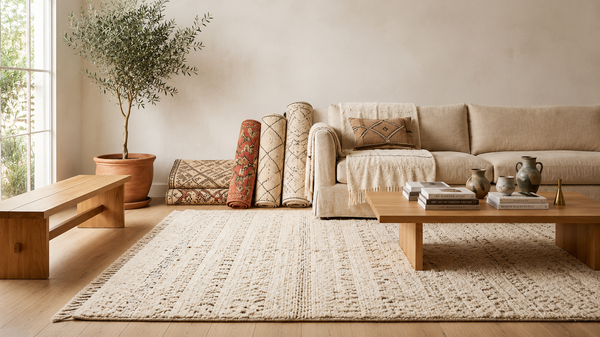
There is a paradox at the heart of the Mrirt rug. It is, by the judgment of most people who have encountered it in person, among the most refined handwoven wool rugs that Morocco produces. And yet it is almost entirely unknown outside the country. While the Beni Ourain has traveled the world and found its way into the vocabulary of contemporary interior design, and the Azilal has built a following among collectors drawn to color and creative individuality, the Mrirt has remained quietly where it began — in the Middle Atlas, made by women whose knowledge of the pile and the loom is among the most technically demanding in the Amazigh tradition.
The reason for this obscurity is instructive. The Mrirt rug does not photograph easily. Its qualities — density, softness, the way the pile holds its structure under the hand and underfoot — are experienced rather than seen. In an era where textiles travel through images, a rug whose essential quality is tactile was always going to struggle for visibility.
This guide is an attempt to correct that. It covers what Mrirt rugs are, where they come from, what makes them materially exceptional, and why they deserve a place in any serious conversation about handwoven wool.
The Mrirt Region: Where Morocco's Most Refined Rugs Are Made
The Middle Atlas Plateau and Its Sheep
The Mrirt region lies in the Beni Mellal-Khénifra province of Morocco’s Middle Atlas, east of the city of Khenifra. It is high plateau country — less dramatically vertical than the High Atlas, but equally demanding in its climate: cold winters, hot summers, an altitude that shapes both the vegetation and the animals that graze on it.
The sheep of the Middle Atlas around Mrirt produce a fleece that is considered, among those who work with Moroccan wool, to be among the finest available. The altitude, the cold season, and the particular grasses of the plateau encourage the development of a fiber that is denser, softer, and more lanolin-rich than wool produced at lower elevation. This wool is the foundation of everything that makes a Mrirt rug what it is.
A Weaving Tradition That Stayed Local
The Mrirt weaving tradition developed largely in isolation from the commercial textile networks that brought other Moroccan rug styles to international attention. While Beni Ourain rugs were being collected by European travelers and artists from the early twentieth century onward, Mrirt rugs were woven primarily for domestic use — as floor coverings, sleeping surfaces, and objects of warmth rather than trade.
This insularity preserved the tradition in an important way. The Mrirt rug was never simplified or standardized for export. It continued to be made the way it had always been made: slowly, densely, by women whose understanding of the pile was built through years of practice.
Why Mrirt Remained Unknown Outside Morocco
The relative obscurity of Mrirt rugs in international markets is partly a function of geography and partly of aesthetics. Geographically, the region was less accessible than the main Berber trading centers. Aesthetically, the Mrirt rug offered something that the export market was slower to appreciate: not pattern, not color, but material quality — density and softness and structural integrity that only becomes apparent when you touch the piece.
That is changing. As the conversation around handwoven textiles has matured, and as collectors and designers have developed more sophisticated criteria for what makes a rug valuable, the Mrirt has begun to attract the attention it deserves.
What Makes a Mrirt Rug Different: The Pile
Pile Height: 1.5 to 2.5 cm
The most immediate physical difference between a Mrirt rug and a standard Moroccan wool rug is the pile. Where a typical handwoven Moroccan rug has a pile height of around 1 to 1.5 centimetres, a Mrirt rug is woven to a pile height of 1.5 to 2.5 centimetres — consistently deeper, consistently denser. The effect underfoot is immediate. You feel the difference before you can articulate it.
This depth is not simply a matter of cutting the pile longer. It is the result of a higher knot density — more individual knots per square centimetre — combined with a compression technique that ensures the pile stands upright rather than lying flat. The combination produces a surface that is both deeper than standard pile and more structurally cohesive.
Knot Density: What It Means in Practice
Knot density is the most reliable technical indicator of a handwoven rug’s quality and durability. A higher knot density means more individual hand-tied knots per unit of surface area, which in turn means a denser, more resilient pile that holds its structure under use and over time.
Mrirt rugs are woven to a knot density that is considerably higher than most other Moroccan rug traditions — not as an end in itself, but as the necessary foundation for the depth of pile that defines the rug. Each additional row of knots is beaten down firmly before the next row begins, compressing the previous work and building the density that makes the surface behave differently from anything produced with a lighter hand.
Why Density Takes Time — and Is Difficult to Reproduce Through Machine Production
The density of a Mrirt rug cannot be rushed, and it is difficult to reproduce through machine production. The compression of each row, the consistent tension of each knot, the gradual building of pile from the bottom of the loom upward — these are processes that depend on the judgment and physical presence of an experienced weaver. A machine can produce a thick pile; it cannot produce the specific structural quality of a Mrirt pile, where the density is the result of thousands of individual decisions made by a single person over weeks of sustained work.
This is not a romantic argument against industrial production. It is a practical observation about what makes the Mrirt rug materially exceptional and why its qualities are difficult to replicate by other means.
The Wool: Why It Matters More in a Mrirt Than in Any Other Rug
Middle Atlas Altitude and Fleece Quality
The wool used in a Mrirt rug begins with sheep raised on the Middle Atlas plateau at significant altitude. The conditions at altitude — cold winters, dry summers, a particular range of highland grasses — produce a fleece with qualities that are readily apparent to anyone who has worked extensively with Moroccan wool. It is denser, more uniform in fiber diameter, and richer in lanolin than wool from lower elevations.
In most rug traditions, the wool is one of several elements that determine the quality of the finished piece. In a Mrirt rug, it is the central element. Because the rug’s distinction lies in its pile — its depth, softness, and resilience — the quality of the wool from which that pile is made is everything. A Mrirt made from inferior wool would be a thicker rug; it would not be a Mrirt rug.
Lanolin Content: Natural Softness That Deepens With Use
The high lanolin content of Middle Atlas fleece gives Mrirt wool two qualities that are immediately apparent and that become more pronounced over time. The first is natural softness — not the surface softness of a treated fiber, but a softness that is structural, present throughout the depth of the pile, and consistent in every direction. The second is a natural resistance to soil and moisture that means the rug maintains its appearance with straightforward care.
What is less immediately obvious, but equally important, is how Mrirt wool behaves over time. The lanolin does not wash out with regular use. It integrates with the structure of the fiber. A Mrirt rug that has been lived with for several years is, in many respects, softer and more responsive underfoot than it was when new. This is the opposite of what happens with synthetic pile, which compresses and loses its structure under use.
Why Mrirt Wool Ages Differently From Lowland Fiber
The comparison between altitude wool and lowland wool is most apparent in how the fibers age. Lowland wool, even when well-prepared, tends to compress more readily under foot traffic, developing a flattened quality that is difficult to reverse. Atlas Mountain wool — and particularly the dense, lanolin-rich fleece of the Mrirt plateau — resists this compression. The fiber has sufficient structural integrity to recover after pressure, returning to something close to its original form.
This resilience depends on how the rug is used and maintained. But it is real, and it explains why well-made Mrirt rugs tend to retain their pile structure and their softness considerably longer than rugs woven from lower-quality fiber.
The Making: Why a Mrirt Rug Takes Longer Than Any Other
Five to Six Weeks of Full-Day Weaving
The total lead time for a Mrirt rug at Soul Rugs is 5 to 6 weeks — the same as our Beni Ourain and Azilal rugs — but the weaving itself, for a Mrirt piece, is among the most time-intensive work in the Amazigh tradition. A medium-sized piece requires sustained full-day work over several weeks, with no stage that can be accelerated without compromising the density that defines the rug.
The time is not spent on complexity of pattern. Mrirt rugs are often visually restrained — their compositions tend toward the quiet, the tonal, the geometric without drama. The time is spent building pile: row by row, knot by knot, with the careful beating-down of each row that creates the density the finished rug will carry.
The Compression Technique: Beating Each Row Into Density
After each row of knots is tied across the width of the loom, the weaver passes a weft thread horizontally and then beats the entire row downward using a comb-like tool. This process compresses the pile, locking each knot into place and building the structural density of the rug from the bottom upward.
In standard Moroccan rug weaving, this beating is relatively light — sufficient to hold the structure together without creating excessive density. In Mrirt weaving, it is deliberate and firm. The weaver beats each row multiple times, ensuring a compression that will hold its character under regular use. This additional work — repeated at every row, throughout the weeks of the rug’s construction — is what distinguishes the Mrirt pile from anything produced with a lighter technique.
Why Experienced Artisans Make Better Mrirt Rugs
The quality of a Mrirt rug is more directly dependent on the experience of the weaver than almost any other Moroccan rug tradition. The pattern, in a Mrirt, is relatively simple. What is not simple is the consistency of the tension, the evenness of the pile height, and the regularity of the compression across the full width and length of the rug. These are skills that develop over years of practice and that are immediately apparent in the quality of the finished surface.
An experienced Mrirt weaver produces a pile that is even in depth, consistent in density, and structurally coherent from edge to edge — a surface whose quality holds over time in a way that a less experienced hand cannot guarantee.
The Surface: What You See, What You Feel
Visual Restraint as a Design Choice
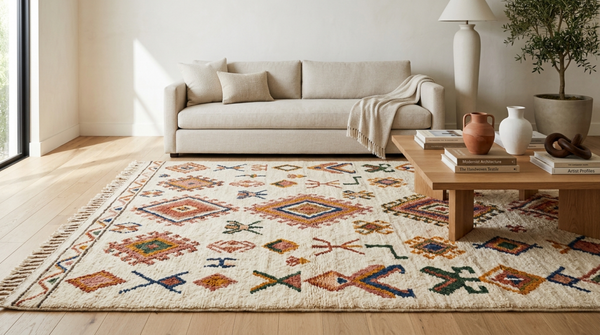
Mrirt rugs are not the most immediately striking objects in the Amazigh tradition. They do not announce themselves the way an Azilal does, with its vivid color and personal compositional energy. They do not carry the graphic clarity of a Beni Ourain’s diamond and line geometry. What they offer instead is something quieter and, for many people who live with them, more enduring: a surface of exceptional material presence that operates below the level of pattern.
The visual restraint of most Mrirt rugs — their tendency toward tonal compositions, their muted palettes, their preference for texture over motif — is not a limitation. It is a considered approach to what a rug can be. In the Mrirt tradition, the rug is not primarily a surface to look at. It is a surface to inhabit.
How the Pile Holds Its Form Over Decades
One of the most practically significant qualities of a well-made Mrirt rug is its structural longevity. Because the pile is dense, compressed, and made from high-quality Atlas Mountain wool, it maintains its depth and softness under regular use far longer than a rug of standard construction.
A Mrirt rug that has been cared for properly — vacuumed regularly, cleaned when needed, rotated to distribute wear — will retain its essential character for many years. The pile does not flatten permanently under furniture. It recovers. The lanolin in the fiber continues to offer a degree of natural resilience that synthetic materials cannot replicate.
What “Under the Foot” Actually Means — The Mrirt Experience
The quality that every person who encounters a Mrirt rug for the first time notices before anything else is the sensation underfoot. It is not simply soft — there are many soft rugs. It is soft in a specific way: dense without being rigid, yielding without losing its structure, warm in the way that only natural wool can be warm. The experience is more closely related to walking on a thick layer of compressed natural fiber than to stepping onto a conventional rug.
This is the quality that Mrirt weavers have been building into their work, and it is the quality that, once experienced, makes other rugs feel slightly different by comparison. It is also, ultimately, the quality that is most difficult to describe to someone who has not felt it — which is why the Mrirt rug has always been better understood through touch than through photography.
The Mrirt in a Luxury Interior
Why Discerning Interior Designers Specify Mrirt Rugs
Among interior designers who work at the upper end of the residential market — architects specifying materials for considered private homes, designers working with clients who understand the difference between a good object and a great one — Mrirt rugs have developed a quiet following. They are not the most commonly specified Moroccan rug; the Beni Ourain still dominates that conversation. But among those who have encountered them, they are often preferred for spaces where material quality matters most.
The reason is straightforward: in a room where everything else is already exceptional — the stone, the joinery, the furniture, the light — the rug needs to perform at the same level. A Mrirt rug, with its density, its natural wool, and its restrained visual character, does this without competing. It adds material richness without introducing visual noise.
The Mrirt and Natural Stone, Oak, Linen: Why They Belong Together
Mrirt rugs sit with particular ease alongside other natural materials. Raw stone — limestone, travertine, slate — shares the Mrirt’s density and weight, and the two materials read as belonging to the same material family. Pale oak has a warmth and grain that responds to the tonal character of natural wool. Linen, in its various weights, shares the Mrirt’s quality of texture-as-surface.
What these materials have in common is that they are experienced rather than simply seen. They reward proximity and touch. They change with light and age. In this company, the Mrirt rug operates naturally, contributing to a room where material quality is the design language.
Bedroom, Living Room, Library: Where a Mrirt Works Best
The bedroom is the most natural home for a Mrirt rug, and the placement that most directly connects to the original function of dense pile weaving in the Atlas: underfoot in the morning, warm against bare skin, transforming the first moments of the day. A Mrirt under a bed — extending well beyond the sides and foot — performs this function better than almost any other rug type.
In a living room, a Mrirt works best as the anchor of a seating group in a room where the other materials are quiet. A library or study, where the rug is in regular direct contact with someone standing or sitting at floor level, allows the quality of the pile to be appreciated continuously.
A Rug That Improves the Room by Doing Less
The Mrirt rug’s contribution to a room is not decorative in the conventional sense. It does not provide pattern or color in the way that an Azilal does. It does not carry the graphic weight of a Beni Ourain. What it provides is something that well-made rooms increasingly prioritize: material presence. The quality that makes a space feel considered rather than simply furnished. The sense that the objects in the room were chosen for what they are, not only for how they look.
Mrirt vs Beni Ourain vs Azilal: Understanding the Difference
Three Traditions, Three Sensibilities
All three rug types in the Soul Rugs collection come from the Amazigh tradition of handwoven wool weaving in the Atlas Mountains of Morocco. They share the same fundamental technique — vertical loom, hand-tied knots, natural wool — and the same essential values: time, skill, material honesty. What distinguishes them is their sensibility.
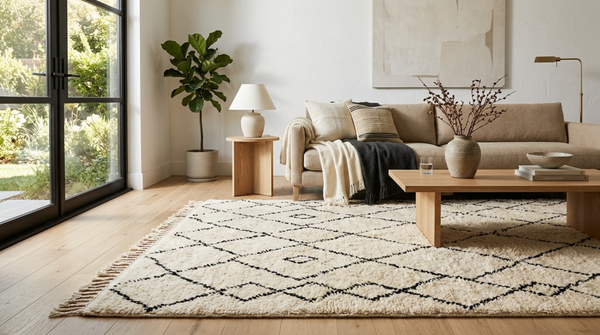
The Beni Ourain is the tradition of heritage and geometry — precise, codified, visually clear. The Azilal is the tradition of personal expression — colorful, intuitive, compositionally free. The Mrirt is the tradition of material excellence — dense, soft, structurally exceptional, visually quiet.
If You Want Texture Over Pattern: Choose Mrirt
The clearest way to choose between the three traditions is to ask what you want the rug to contribute. If the answer is a strong visual presence — pattern, geometry, graphic energy — the Beni Ourain or Azilal is the natural choice. If the answer is material quality — depth, softness, structural longevity, the sensation of exceptional wool underfoot — the Mrirt is the rug that will deliver most completely.
This is not a question of one tradition being superior to another. It is a question of what a particular room or a particular person values most. For those who prioritize the tactile over the visual, the Mrirt is among the most considered choices in the Amazigh weaving tradition.
Can a Mrirt and a Beni Ourain Coexist?
Yes, and the combination works particularly well. A Beni Ourain in a living room — where its graphic character can be appreciated from a distance — and a Mrirt in a bedroom or study, where its pile quality is experienced directly. The two rugs speak to different aspects of the same tradition, and in different spaces they can be equally right.
Frequently Asked Questions
What is a Mrirt rug?
A Mrirt rug is an authentic handwoven Moroccan wool rug made by Amazigh women artisans in the Mrirt region of Morocco’s Middle Atlas Mountains. These rugs are distinguished by their exceptionally dense pile, high-quality Atlas Mountain wool, and the remarkable softness and structural longevity that result from their construction.
Why are Mrirt rugs widely regarded as among the most luxurious Moroccan rugs?
The distinction comes from their pile construction. Mrirt rugs are woven to a pile height and knot density that is considerably greater than most other Moroccan rug traditions, using high-quality lanolin-rich wool from Middle Atlas sheep. The result is a surface that is exceptionally soft, structurally resilient, and slow to compress under use — qualities that improve rather than diminish with careful use over time.
How long does it take to make a Mrirt rug?
At Soul Rugs, total lead time from order to delivery is 5 to 6 weeks. The weaving itself is among the most time-intensive work in the Amazigh tradition: each row of knots requires careful compression, and the density of the pile cannot be accelerated without compromising the quality that defines the rug.
How does a Mrirt rug feel underfoot?
Dense, yielding, and warm in a way that is specific to high-quality natural wool at significant pile depth. The sensation is often described by people encountering it for the first time as unlike any other rug — more closely related to standing on a thick layer of compressed natural fiber than to stepping onto a conventional floor covering. It is a quality that is experienced rather than easily described.
How do Mrirt rugs compare to Beni Ourain rugs?
Both are Amazigh handwoven wool rugs from the Middle Atlas. The Beni Ourain is distinguished by its visual character — natural ivory ground, bold geometric motifs, medium pile — and has become one of the most recognized Moroccan rug traditions internationally. The Mrirt is distinguished by its material character — exceptional pile depth, greater knot density, and a surface quality that prioritizes touch over pattern. For a full guide to the Beni Ourain tradition, see What is a Beni Ourain Rug?
How do I care for a Mrirt rug?
Vacuum regularly with a low-suction setting, moving in the direction of the pile. Spot clean with cold water and a pH-neutral detergent. Dry flat in shade. Rotate every few months for even wear. Professional cleaning once a year is recommended. The dense pile construction means that surface dust does not penetrate easily — regular vacuuming is typically sufficient for day-to-day maintenance.
Do you ship worldwide?
Yes. Every Soul Rugs piece ships free via DHL Express from our atelier in Marrakech. Once weaving is complete, delivery typically takes 5 to 7 business days via DHL Express.
Explore our Mrirt collection — each piece made to order by an Amazigh artisan woman in the Middle Atlas Mountains of Morocco. For the full picture of Moroccan rug traditions, see The Complete Guide to Moroccan Rugs. Or read Our Story to learn about the people behind every rug.