The last row may be woven, but the work of making a Moroccan wool rug is not always finished. From the Atlas Mountains to the final touch of the hand, the finishing matters as much as the weaving.
MATERIALS & CRAFT — SOUL RUGS
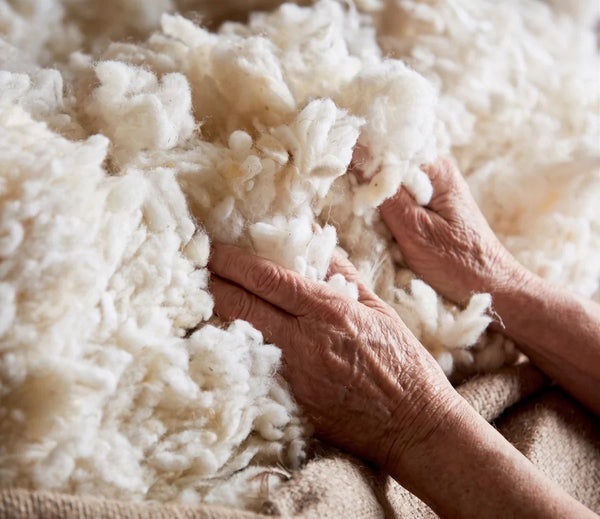
There is something about natural wool that you only understand when you have held it in your hands.
You feel its warmth before you notice its colour. You feel the resistance of the fibre, its softness, and the way it moves under your fingers. For someone familiar with Moroccan rugs, these qualities tell a story long before the pattern comes into view.
In the Atlas Mountains, Amazigh women have passed down the knowledge of working with wool through generations. Weaving is not simply about reproducing a design. It is about understanding the material and knowing how it behaves.
At Soul Rugs, this is the spirit behind the handmade Moroccan rugs we value and create.
The familiar diamond patterns of a Beni Ourain, the deep texture of a Mrirt, the expressive colours of an Azilal or Boujaad, and the flatwoven geometry of a Moroccan kilim may look very different. Yet each depends on skilled hands and an understanding of its construction.
And once the weaving is finished, another part of the work begins.
A Moroccan Rug Is Not Finished When It Leaves the Loom
Imagine a weaver reaching the final row of a large wool rug.
For weeks, she has guided the yarn across the loom, adjusting tension, following the design and working patiently through each section.
When the rug is released, its character is already visible.
But a handmade rug may still need to be trimmed, cleaned, checked, washed or dried, depending on its construction and the methods used by the workshop.
These final stages are easy to overlook.
They are less dramatic than the sight of a loom surrounded by wool. Yet they affect the way the finished rug looks, feels and settles into a room.
For an experienced rug maker, attention to the details does not stop with the last row. For the earlier stages at the loom, read how Moroccan rugs are made.
Understanding Natural Atlas Mountain Wool
Wool is one of the reasons Moroccan rugs have such a distinctive character.
Its natural crimp gives it resilience. Its fibres can absorb moisture, and its structure contributes to the warmth and texture that make wool rugs appealing.
But natural wool also needs careful handling, particularly when wet.
A freshly washed rug can become surprisingly heavy. Depending on its thickness, its foundation may retain moisture after the visible surface has begun to dry.
A dense Mrirt rug will not behave like a flatwoven kilim.
That difference matters.
It is why experienced people working with wool pay attention to the textile itself, rather than assuming that every rug should be cleaned and dried in exactly the same way. Our article on Atlas Mountain wool and the craft of a Mrirt rug looks more closely at the fibre, yarn and texture.
Washing and Drying a Handmade Moroccan Rug
Depending on the workshop and the rug, washing may form part of the finishing process.
It can help remove residues from production and prepare the finished textile for use.
The exact method depends on the fibre, the dyes, the construction and the workshop's practices.
After washing, the wool must be allowed to dry appropriately.
Good airflow helps moisture escape. Proper support helps protect the structure while the rug is heavier than usual.
And patience matters because a rug that feels dry at the surface may still hold moisture deeper within its foundation.
The purpose of drying is not to give the wool the longest possible exposure to the sun.
It is to reach an appropriate, thoroughly dry condition without unnecessary stress on the material.
Why Air Circulation Matters
Moisture should not remain trapped in the pile or foundation.
Appropriate ventilation helps the textile dry more consistently and reduces the risk of dampness and unpleasant odours.
For thick-pile Moroccan rugs, the underside deserves attention as well as the surface.
Does Direct Sunlight Help?
Outdoor drying is part of some traditional textile practices, especially in suitable weather.
But stronger heat is not always better.
Prolonged intense sunlight may affect certain colours, while excessive heat can be unsuitable for delicate wool.
The right approach depends on the rug, its dyes and the surrounding conditions.
Why Wet Wool Must Be Supported
A large wool rug becomes heavier after washing.
If handled carelessly while wet, its weight can put unnecessary tension on the textile.
Supporting the rug appropriately during handling and drying helps protect its shape.
Midelt, Azilal and the Landscapes of the Atlas Mountains
The Atlas Mountains are not a single landscape.
From the high plains around Midelt to the valleys of Azilal, the terrain, seasons and local traditions change.
These places are important geographical references for Soul Rugs and for the wider heritage of Amazigh wool weaving.
Midelt — Mountain Wool and Changing Seasons
Midelt lies between the Middle Atlas and the eastern High Atlas.
Its mountain setting brings strong seasonal contrasts, including cold winters.
Here, the weather is a reminder that natural materials respond to their environment.
Wool, moisture and temperature must be understood together.
The relationship between people, animals, landscape and textile-making is part of the broader cultural setting in which Atlas Mountain wool is valued.
Azilal and the Central High Atlas — Weaving With Individuality
The valleys around Azilal, in the Central High Atlas, are associated with a rich Amazigh weaving heritage.
Azilal rugs are loved for their expressive character.
Their lines may be irregular. Their colours can be surprising. Their motifs often feel closer to spontaneous drawings than to mechanical repetition.
A handmade Azilal rug is not meant to look like an identical copy of another.
The finishing should respect the individuality of its construction and materials.
Ouarzazate — Beyond the High Atlas
Further south, Ouarzazate lies near the gateway to Morocco's desert landscapes.
Its generally drier environment contrasts with the conditions found in many mountain valleys.
This difference helps explain why climate and season matter when natural wool is handled and dried.
There is no single Moroccan town or climate that is automatically the correct setting for every rug.
The important thing is to match the finishing method to the material and the conditions.
Five Moroccan Rug Traditions, Five Different Characters
Anyone searching for an authentic Moroccan rug soon discovers that not every Berber rug is woven in the same way.
The differences go beyond pattern and colour.
Construction, texture, pile and finishing all contribute to the identity of a rug.
Beni Ourain Rugs — Natural Softness and Geometry
Beni Ourain rugs are known for their wool texture, often combining an ivory background with simple geometric motifs.
Their beauty lies in the balance between material and design.
Finishing should preserve the natural character of the pile while allowing the pattern to remain clear.
For buyers drawn to a calm, timeless handmade Moroccan rug, Beni Ourain remains a distinctive tradition.
Explore Soul Rugs Beni Ourain rugs.
Mrirt Rugs — Wool Pile and Texture
Many Mrirt rugs are valued for the density and depth of their wool pile. The construction and pile profile of the individual model still matter.
Its texture is something you understand best by touch.
For a thick-pile model, that depth demands attention during finishing and drying, because moisture may remain beneath the visible surface.
The aim is to respect the structure of the wool while preserving the softness and depth that make Mrirt rugs so desirable.
Explore Soul Rugs Mrirt rugs.
Azilal Rugs — Colour and Creative Expression
Azilal rugs celebrate expressive lines, unexpected colour combinations and the individuality of the weaver.
With coloured wool, the response of dyes to water and light becomes an important consideration.
A careful finishing process protects the character of the design without forcing every surface to appear mechanically uniform.
Explore Soul Rugs Azilal rugs.
Boujaad Rugs — Warm Colours and Expressive Motifs
Boujaad rugs are admired for their rich visual character, often featuring warm tones, abstract compositions and lively geometric patterns.
Their appearance can vary significantly from one piece to another.
Where coloured wool is used, cleaning and finishing must take dye stability and construction into account.
For buyers searching for a colourful handmade Moroccan rug with a strong individual character, Boujaad offers a particularly expressive choice.
Moroccan Kilim Rugs — The Art of the Flatweave
A Moroccan kilim is different from a pile-woven Mrirt or Beni Ourain rug.
Kilim rugs are flatwoven, without the knotted pile found in many other Moroccan rug constructions.
This creates a flatter surface and a different relationship between the threads and the design.
Flatwoven rugs also require finishing and cleaning appropriate to their structure.
A kilim should not be treated as though it were simply a thinner version of a plush wool rug.
Handmade Moroccan Rugs vs Machine-Made Rugs
People often ask what makes a genuinely handmade Moroccan rug different from a factory-produced one.
The answer begins with its construction.
A machine-made rug is produced through a repeatable manufacturing process.
A handmade rug reflects the work of its maker. Its tension, knots, edges and patterns can reveal subtle variations resulting from hand production.
These details should be understood in context: an irregularity is not automatically proof of authenticity, and good workmanship still requires consistency where it matters.
What distinguishes an excellent handmade rug is the combination of skilled weaving, appropriate materials and careful finishing.
How to Recognise a Well-Finished Moroccan Rug
When buying a handmade Moroccan wool rug online, look beyond the overall photograph.
Examine the wool texture, the definition of the pattern and the condition of the edges.
Pay attention to the fringes and, where photographs are available, the underside and construction.
Ask about the materials, the weaving method and the finishing process.
For a made-to-order rug, plan the measurements with our Rug Size Guide and understand that small variations can occur during hand production.
The aim is not to search for industrial perfection.
It is to recognise skilled workmanship and an honestly described handmade textile.
How Long Does It Take to Make a Moroccan Rug?
A handmade Moroccan rug takes time because its construction requires skilled work.
Size, pile density, design complexity and weaving technique can all influence production.
At Soul Rugs, the usual weaving and production period is approximately 3–5 weeks.
The estimated total time between placing an order and receiving the finished rug is 5–6 weeks, including delivery. Some orders may take longer depending on production and transport conditions.
The finishing stages belong within the overall production process and should not automatically be presented as additional weeks beyond the quoted lead time.
When choosing a custom Moroccan rug, allowing enough time is part of planning for a genuinely handmade piece.
How to Care for a Handmade Wool Rug at Home
The washing and finishing of a new rug are not the same as everyday cleaning at home.
Natural wool generally benefits from gentle, regular care. Follow the care instructions for the individual rug.
Vacuum appropriately for the rug's construction. Avoid aggressive brushing of delicate pile or fringes.
Address spills promptly without harsh rubbing.
If a rug becomes wet, ensure appropriate ventilation and support while drying.
Avoid excessive direct heat and prolonged strong sunlight.
For extensive washing, a professional experienced with handmade wool rugs is usually the safer choice.
A dense-pile rug and a Moroccan flatweave may need different cleaning approaches.
The Human Touch Behind Every Soul Rug
There is a reason people continue to choose handmade Moroccan rugs.
It is not simply because they look beautiful in a living room.
It is because the material carries the work of real hands.
The women who weave Soul Rugs bring years of experience to their craft. Each row of wool represents concentration, physical work and knowledge passed between generations.
The finished rug preserves something of that effort.
A good rug should feel right when you touch it. Its design should belong to its construction. Its materials should be described honestly.
For us, the value of an Amazigh rug is not found in pretending that every piece is identical.
It is found in the care behind making something individual.
And that care continues beyond the loom.
Frequently Asked Questions About Moroccan Wool Rugs
How are handmade Moroccan rugs finished?
Depending on their construction and the workshop's practices, finishing can involve trimming the pile, securing edges, cleaning, washing, drying and inspection.
Why are some Moroccan rugs washed after weaving?
Washing can help remove residues associated with production and prepare the textile for its final presentation. The method must suit the fibre and dyes.
How long does a Moroccan wool rug take to dry?
There is no universal duration. Thickness, rug size, construction, temperature, airflow and humidity all affect drying.
Can a Moroccan wool rug dry in direct sunlight?
Some workshops use outdoor drying in suitable conditions. Prolonged intense sunlight is not appropriate for every rug or dye.
What is the difference between a Mrirt rug and a Moroccan kilim?
A pile-woven Mrirt has a raised wool surface; a kilim is flatwoven without a knotted pile. Check the construction of the individual rug.
Are Boujaad rugs handmade?
Traditional Boujaad rugs belong to Morocco's handmade weaving heritage. When purchasing a contemporary piece, check its actual materials and manufacturing method.
Are handmade Moroccan wool rugs durable?
Well-constructed wool rugs can offer long-lasting use with appropriate care. Durability depends on the materials, construction, use and maintenance.
Where can I buy handmade Moroccan rugs?
Explore the published Soul Rugs collections for current availability, or discuss made-to-order dimensions and designs through our custom rug service.
Discover Handmade Moroccan Rugs at Soul Rugs
A Moroccan rug is more than a pattern.
The wool, the weaving, the finishing and the skill of the artisan all contribute to its character.
Explore the published Soul Rugs collections above, or discover our custom rug options to find a handmade piece suited to your space.
Rooted in Amazigh craftsmanship. Woven by hand. Made for your home.