Every Moroccan rug begins with a story — and that story starts with the sheep. In the Atlas Mountains, sheep roam freely at altitudes above 2,000 meters. Their wool is thick, resilient, and naturally lanolin-rich, making it perfect for weaving.
Step 1: Shearing and Washing
The wool is sheared by hand, typically in spring. It is then washed in mountain streams to remove dirt and oils, and laid out to dry in the sun.
Step 2: Carding and Spinning
Once dry, the wool is carded — combed to align the fibers — and then hand-spun on a drop spindle. This centuries-old technique produces yarn that is irregular and textured, giving each rug its distinctive character.
Step 3: Dyeing
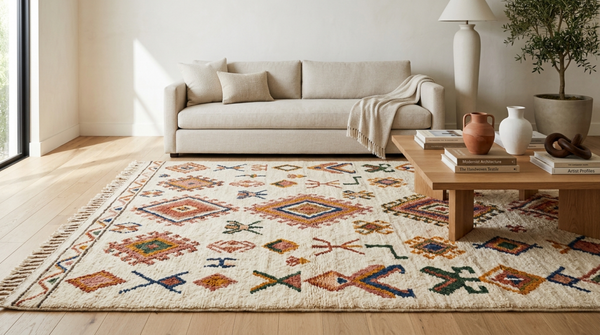
For colored rugs (like Azilal or Boujaad styles), the yarn is dyed using natural pigments from plants, minerals, and insects. Traditional natural dye sources can include indigo for blue, madder root for reds, and pomegranate skins for yellow and ochre tones. Some weavers now use synthetic dyes for brighter, more consistent colors.
Step 4: Weaving
The weaver sets up a traditional vertical wooden loom and begins knotting or flat-weaving the rug by hand. Depending on the size and complexity, a single rug can take anywhere from 2 weeks to 6 months to complete. The weaver works from memory — there are no written patterns.
Step 5: Finishing
Once complete, the rug is cut from the loom, and the fringes are knotted or braided. The rug is then washed one final time and laid in the sun to dry.
The Craft in Context
Watching wool travel from fleece to finished pile changes how a rug is seen. Choosing which tradition belongs in a room is the natural next thought, considered throughout our Guide to Moroccan Rugs.
The result is a piece of living art — one that carries the soul of its maker, the warmth of Atlas wool, and a weaving tradition passed down through generations.